By Priya Shenoy – Food writer based in London. My family is from Udupi, coastal Karnataka. I grew up eating Mangalore buns at my grandmother’s table in Udupi and have spent the last several years writing about the food of the Karnataka coast for UK audiences.
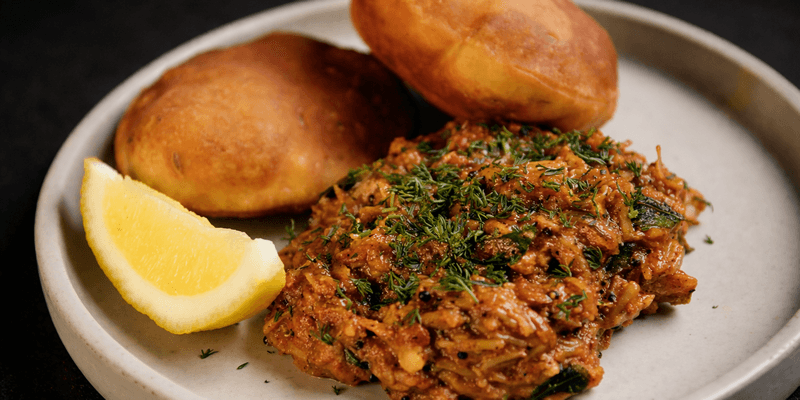
I need to be honest about what this recipe is and isn’t. Mangalore buns — buns in the Tulu sense, a soft fried bread made with overripe banana — are something I ate most Sunday mornings as a child in Udupi. My grandmother made them without weighing anything, judging the dough entirely by feel, and served them with coconut chutney and a thin sambar. They are not traditionally a vessel for crab filling. They are a breakfast food, slightly sweet, eaten simply.
What Avi Shashidhara has done on Saturday Kitchen — and what this recipe reproduces — is a creative adaptation that takes the bun and uses it as a platform for a Mangalorean-style crab sukka. I think it works well. The sweetness of the banana dough does something interesting against the heat and funk of the crab. But I want to be clear that you are making a chef’s interpretation of a traditional dish, not the dish itself. If you want to understand what Mangalore buns actually are, make them once with just coconut chutney. Then make this.
The first time I tested this version in my London kitchen I used fresh coconut — I can get it from the Tamil grocers on Tooting High Street — and the sukka was noticeably better than with coconut milk powder. I’ve included both options below.
Prep Time: 30 minutes (plus overnight chilling) | Cook Time: 50 minutes | Total Time: 1 hour 20 minutes (plus chilling) | Servings: 5
Author: Priya Shenoy (tested in my London kitchen, March 2026) Original recipe: Avi Shashidhara, Saturday Kitchen, BBC. This post reproduces the core recipe with additional cultural context and testing notes.
Why This Recipe Works
Mangalore buns belong to the coastal Karnataka culinary tradition, where overripe bananas are used in everything from curries to sweets to fried breads. The banana serves two purposes in the dough: it adds moisture and a gentle sweetness, and its natural sugars help the buns colour evenly in the oil. The bicarb and baking powder do the leavening — this is not a yeast dough — and the overnight chill is important because it firms the yoghurt fat and makes the dough far easier to handle and cut.
The crab sukka is a dry or semi-dry preparation typical of the Karnataka and Kerala coasts, built on a base of mustard seeds, curry leaves and coconut. Sukka (or sukke in Tulu) refers to the dry style of the dish rather than a specific spice blend — it distinguishes this from a wet curry. Traditionally it uses freshly grated coconut added late in the cooking so it toasts slightly in the pan. The coconut milk powder in Avi’s version is a practical substitution that gives you the fat and coconut flavour in a concentrated, shelf-stable form. It works, though if you have access to fresh or frozen grated coconut, use it — the texture and flavour are meaningfully different.
The calcots are Avi’s own addition and the most distinctly non-regional element. Calcots are a Catalan spring onion variety, and their appearance here is about flavour contrast — the char and sweetness against the spiced crab — rather than any cultural connection. The hemp seed chutney is similarly a creative departure from tradition; a Mangalorean cook would serve this with a coconut chutney. I’ve kept both elements because they work, but it’s worth knowing that neither is traditional.
Cooking Notes from My Kitchen
The dough is more forgiving than it looks. If your bananas are very ripe — properly black-skinned — the dough will be slightly wetter. Add an extra tablespoon of flour rather than breadcrumbs, which can make the texture slightly gluey if overdone. The dough should feel like a soft bread dough after kneading: tacky but not sticky, smooth enough to roll without tearing.
Oil temperature is the single most important variable in frying the buns. At the right temperature — around 180–190°C rather than the 200°C in the original recipe, which I found coloured them too fast before they cooked through — they should take 3–4 minutes per side and puff gently. Drop a small piece of dough in first: it should rise to the surface within two seconds and bubble steadily. If it sinks and sits there, the oil is too cold. If it browns in under a minute, pull the heat back.
For the sukka, the key moment is when the oil begins to separate at the edges of the tomato paste — a thin orange ring around the mixture. This tells you the tomatoes have fully broken down and the spices have cooked through properly. Don’t add the coconut element until you’ve reached this point.
Ingredients
For the buns
- 188g Greek-style yoghurt
- 2 very ripe bananas, peeled (black-skinned is ideal; the riper the banana the more flavour)
- 450g plain flour, plus extra for dusting
- 8g fine salt
- ½ tsp cumin seeds, lightly crushed
- 4g bicarbonate of soda
- 4g baking powder
- 50g icing sugar
- Approximately 1.2 litres sunflower oil, for deep frying
For the crab sukka
- 3 tbsp sunflower oil
- 1 tsp black or yellow mustard seeds
- 1 bunch fresh curry leaves (15–20 leaves; dried will not work here)
- 3 Bombay onions or banana shallots, peeled and finely chopped
- 5 green bird’s-eye chillies, finely chopped (reduce to 3 if you prefer less heat)
- 2 tbsp finely grated fresh root ginger
- 2 tsp Kashmiri chilli powder (gives colour and mild heat; substitute half the quantity of regular chilli powder if unavailable)
- 2 tsp coriander seeds, lightly crushed
- 250g tin San Marzano tomatoes or good quality whole plum tomatoes
- 3 tbsp coconut milk powder or 60g freshly grated coconut (see notes)
- 1kg cooked, picked crab meat — this is picked weight, not whole crab weight. Brown and white meat both work; a mix gives better flavour. Ask your fishmonger to pick it, or buy it ready-picked from a good fishmonger or online supplier.
- Salt, to taste
To garnish: fennel fronds and fried curry leaves
For the calcots
- 2 tbsp olive oil
- 6 calcots, trimmed (available from good greengrocers January–April; substitute large spring onions outside the season)
- Flaky sea salt
For the hemp seed chutney
- 300g hulled hemp seeds
- 1 tsp cumin seeds
- Juice of 1 lemon
- 5 dried red chillies
- 1 red pepper, charred under the grill and skin removed
- Salt and freshly ground black pepper
- Water, to adjust consistency
Essential equipment
- Food processor or blender (for the dough base)
- Stand mixer with dough hook, or 10 minutes of hand kneading
- Deep, heavy-bottomed pan or deep fat fryer
- Kitchen thermometer (useful but not essential — see oil temperature notes above)
- Griddle pan
- Pestle and mortar or small blender (for the chutney)
Instructions
The buns
- Blend the yoghurt and bananas together until completely smooth — no banana lumps.
- In the bowl of a stand mixer, combine the flour, salt, cumin seeds, bicarbonate of soda, baking powder and icing sugar. Pour in the banana-yoghurt mixture.
- Knead on a medium speed for 6–8 minutes until you have a smooth, slightly tacky dough. It will be softer than a bread dough. Cover with a clean cloth and refrigerate overnight, or for a minimum of 1 hour. Overnight makes a meaningfully better dough.
- When ready to cook, heat your oil in a deep, heavy pan over a medium-high heat to 180–190°C. Test with a small piece of dough before frying the full batch.
- On a lightly floured surface, roll the dough to approximately 5mm thickness. Cut into circles about 10cm in diameter.
- Fry in small batches — two or three at a time — for 3–4 minutes per side until deep golden brown. They should puff slightly as they cook. Transfer to kitchen paper to drain.
What can go wrong: if the buns come out flat, dense and greasy, the most likely cause is insufficient chilling time. The cold firms the dough and helps it hold structure in the hot oil. There is no real fix for this batch, but they can still be split and filled — they’ll be denser but still good.
The crab sukka
- Heat the oil in a large frying pan over a medium-high heat. Add the mustard seeds and curry leaves together — stand back as the leaves will spit immediately. Cook for 30–40 seconds until the seeds are popping and the leaves have crisped.
- Add the onions, chillies and ginger. Fry, stirring frequently, for around 10 minutes until the onion is soft and beginning to colour at the edges.
- Add the Kashmiri chilli powder and crushed coriander seeds. Reduce to a low heat and cook for 5 minutes, stirring occasionally, until the spices smell fragrant rather than raw.
- Add the tomatoes, breaking them up with a spoon, and season with salt. Cook over a medium heat for around 10 minutes, stirring periodically, until the tomatoes have completely broken down. You are looking for the oil to begin separating around the edge of the mixture — an orange ring. This is your signal that the base is properly cooked.
- If using coconut milk powder: stir it in now and cook for a further 3–4 minutes until the mixture forms a thick, cohesive paste. If using fresh grated coconut: add it now and cook, stirring, for 4–5 minutes until the coconut has absorbed the sauce and begun to dry out slightly. The texture should be closer to dry than wet.
- Add the crab meat and stir until fully incorporated and warmed through. Taste for seasoning and adjust salt.
The calcots
- Heat a griddle pan until smoking. Toss the calcots in olive oil and a pinch of sea salt. Grill, turning occasionally, for 8–10 minutes until properly charred on the outside and soft all the way through.
The hemp seed chutney
- Toast the hemp seeds and cumin seeds in a dry frying pan over a medium heat, stirring constantly, until the seeds deepen slightly in colour and smell nutty — around 4–5 minutes. Watch carefully; they can turn bitter quickly. Set aside a tablespoon of the toasted seeds for garnish.
- Grind the remaining toasted seeds with the dried chillies, grilled red pepper and lemon juice in a pestle and mortar or small blender to a rough paste. Add water, a tablespoon at a time, to reach a thick but spoonable consistency.
- Season well with salt and pepper and taste — the chutney should be nutty, slightly smoky from the pepper, with a clean chilli heat.
To serve
- Split the warm buns and fill generously with the crab sukka. Garnish with fennel fronds and fried curry leaves. Serve alongside the chargrilled calcots with the hemp seed chutney on the side.
Nutrition (Approximate)
Rough estimates per serving. Not calculated against a nutritional database and will vary with oil absorption during frying, fat content of the crab meat, and portion size.
- Calories: approximately 700–760 kcal
- Protein: approximately 44g
- Carbohydrates: approximately 60g
- Fat: approximately 30g
- Fibre: approximately 7g
Troubleshooting
Buns are dense and haven’t puffed. Almost always a chilling issue — the dough wasn’t cold enough when it hit the oil. Check your oil temperature too; if it’s below 180°C the buns will absorb oil and sit heavy rather than puff and colour.
Crab filling is watery and making the buns soggy. The sukka wasn’t reduced far enough, or the tomatoes were particularly wet. Return the pan to a medium heat and cook the mixture down, stirring frequently, until it holds its shape on a spoon before adding the crab.
Chutney tastes bitter. The hemp seeds were likely over-toasted. This batch can’t be rescued — the bitterness doesn’t cook out. Start the chutney again with fresh seeds, keeping the heat lower and stirring more frequently. The change in colour is subtle; go by smell.
Expert Tips
On the coconut: If you live near a South Asian or Caribbean grocers, look for frozen grated coconut — it’s far more available than fresh and performs nearly as well in this recipe. Desiccated coconut is a more distant substitute but will work if you soak it briefly in warm water first to rehydrate.
On sourcing crab: Dorset and Cornwall have excellent brown crab from spring through autumn. Buying whole cooked crabs and picking them yourself is significantly cheaper than buying ready-picked meat, though it takes time. A 1.5–2kg cooked cock crab yields roughly 350–450g of picked meat, so budget for 3–4 crabs for this recipe.
On the calcots: Their season runs roughly January to April in the UK. They’re increasingly available at farmers’ markets and independent greengrocers in larger cities. Large spring onions are a workable substitute; standard salad spring onions are too thin and will burn before they soften.
On the bun dough: If you want to understand the traditional bun without the crab filling, make the dough as written and serve the fried buns warm with a simple coconut chutney — grated coconut, green chilli, a little ginger, tempered with mustard seeds and curry leaves. It’s worth doing at least once to understand what the bun actually is before using it as a vehicle for other things.
About the Author
Priya Shenoy is a food writer based in London. She grew up in a Mangalorean family with roots in Udupi, coastal Karnataka, and writes about South Indian coastal cuisine for UK audiences. Her work focuses on the food of the Karnataka and Kerala coasts, and on the gap between how these cuisines are represented in UK food media and what they actually are.
Sources
- Avi Shashidhara, Saturday Kitchen, BBC — original recipe, the direct basis for this post.
- Charmaine Solomon, The Complete Asian Cookbook (Hardie Grant, updated edition 2011) — background on Karnataka coastal cuisine and sukka-style preparations.
- Madhur Jaffrey, Curry Nation (Ebury Press, 2012) — context on South Indian coconut-based cooking and regional variation.
Inspired by Avi Shashidhara’s Saturday Kitchen recipe. Cultural context and testing notes are the author’s own, based on personal heritage and kitchen experience.