
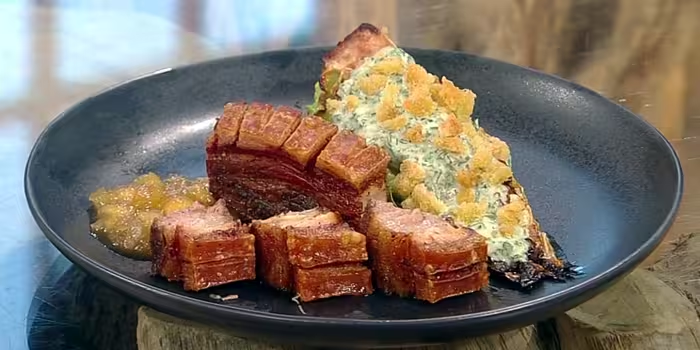
Slow-roasted pork belly with fennel-rubbed golden crackling and meltingly tender meat, served with charred hispi cabbage, tangy buttermilk and herb dressing, crunchy croutons and classic apple sauce.
 Original recipe by Matt Tebbutt
From Saturday Kitchen 07 Nov 2026
Optimised by our culinary team – 6 possible customisations, a 4-stage timed method, and 2 curated wine pairings.
 Pork belly provides protein and iron; cabbage adds fibre and vitamins. Higher saturated fat content keeps this from an A rating. Enjoy as a satisfying main meal with plenty of vegetables and balance with lighter dishes throughout the day.
Shop the Recipe
The kit that makes this recipe easy:
- Pestle and mortar – a must for grinding fennel seeds and peppercorns to release maximum aromatic flavour
- Heavy-based roasting tin with rack – ideal for air circulation and perfect crackling that crisps evenly
- Large frying pan – great for charring cabbage to tender, sweet perfection with smoky edges
- Meat thermometer – perfect for checking pork is cooked through without overcooking



Ingredients
For the pork belly
- 1kg/2lb 4oz bone-in pork belly, rind scored
- 2 tsp fennel seeds
- ½ tsp black peppercorns
- 2 tbsp salt
- 50ml/2fl oz white wine vinegar
For the vinaigrette
- 3 tbsp olive oil
- 1 tbsp Moscatel vinegar
- 1 tsp Dijon mustard
- salt and pepper, to taste
For the cabbage
- 1 hispi cabbage
- 2 tbsp olive oil
- salt and pepper, to taste
For the buttermilk dressing
- 50ml/2fl oz buttermilk
- 1 tbsp chopped mixed chives, tarragon and parsley
- 1 tbsp vinaigrette (from above)
- salt and pepper, to taste
To serve
- apple sauce
- croutons
Customise
- Pork cut – use pork shoulder if belly is unavailable; cooking time remains similar but crackling will not form
- Cabbage swap – savoy or sweetheart cabbage work well; cut into wedges and cook until tender with charred edges
- Buttermilk swap – mix 50ml milk with 1 tbsp lemon juice and leave 10 minutes; or use plain yoghurt thinned with a little milk
- Vinegar – use sherry vinegar or good-quality white wine vinegar if Moscatel is hard to find
- Herbs – use tarragon alone for a classic French flavour; add dill or chervil to vary
- Dairy-free – use plant-based buttermilk or coconut yoghurt thinned with oat milk; recipe is naturally egg-free and nut-free as written
How the timings work
- Rub pork the night before – overnight rest dries rind for ultimate crisp crackling; plan ahead but hands-off
- Prep vinaigrette first – makes one batch, reserves 1 tbsp for dressing; keeps well at room temperature
- Start pork at high heat – first 30 mins blasts crackling; reduce heat and slow-roast for tender meat
- Char cabbage while pork rests – 8 to 10 mins on medium heat; dress warm so it absorbs flavour
- Whisk dressing and plate last – 5 mins; serve immediately so croutons stay crisp
Method
Marinate and roast the pork (overnight + 2 hrs)
- Grind spices – put 2 tsp fennel seeds and ½ tsp peppercorns into a pestle and mortar. Crush coarsely – don’t reduce to fine powder.
- Rub and rest – massage spice mix all over the pork flesh side. Leave rind clear. Place on a rack over a plate, uncovered, in the fridge overnight. This dries the skin for crisp crackling.
- Preheat and season – heat oven to 220C/200C Fan/Gas 7. Pat rind very dry. Rub 2 tbsp salt and 50ml white wine vinegar thoroughly into scored skin.
- High heat blast – place pork on a rack in a roasting tin with 200ml water in the base. Roast 30 minutes – crackling should start to bubble and crisp.
- Slow roast – lower to 180C/160C Fan/Gas 4. Cook 2 hours more. Check with skewer – juices run clear, no pink. Rest 15 to 20 minutes before carving.
Make vinaigrette and dressings (10 mins)
- Whisk base – combine 3 tbsp olive oil, 1 tbsp Moscatel vinegar and 1 tsp Dijon mustard in a bowl. Season with salt and pepper. Whisk until emulsified and smooth.
- Reserve and dress cabbage – set aside 1 tbsp for the buttermilk dressing. Use remainder to dress warm charred cabbage.
- Finish creamy dressing – mix 50ml buttermilk, chopped chives, tarragon and parsley, plus the reserved 1 tbsp vinaigrette. Season. It should pour easily.
Char the cabbage (10 mins)
- Prep and heat – cut hispi cabbage into 4 equal wedges, keeping core intact so it holds together. Season. Heat 2 tbsp olive oil in a large frying pan over medium heat.
- Char and soften – add cabbage wedges. Cook 8 to 10 minutes total, turning occasionally, until golden on all cut sides and tender through. Transfer to a plate and drizzle with most of the vinaigrette while still warm.
Carve and serve (10 mins)
- Carve pork – lift pork from bone. Slice into portions with crackling attached – use a sharp knife to keep crackling intact.
- Plate up – arrange pork wedges on plates alongside dressed cabbage. Spoon apple sauce to the side.
- Drizzle and scatter – spoon buttermilk dressing generously over or beside the cabbage. Scatter with croutons for crunch. Serve immediately.
Techniques for Success
- Dry the rind overnight – moisture is the enemy of crackling. Leave uncovered in the fridge; pat completely dry before salting. Success: deep golden, bubbly, crisp crackling that cracks audibly. Failure: rubbery, soggy, pale skin that never crisps properly.
- High heat first, low heat second – initial blast starts crackling; slow cook tenderises meat. Don’t rush the low-temperature stage. Success: crisp top, juicy meat that pulls apart easily. Failure: burnt crackling with tough, underdone meat beneath.
- Char cabbage, don’t boil it – medium heat, time to colour on each face. It should be tender but still have texture and sweet smoky edges. Success: golden charred outside, tender sweet inside. Failure: grey, watery, overcooked cabbage with no flavour.
| Technique | Failure if done wrong | Success looks like |
|---|---|---|
| Drying pork rind | Soggy, rubbery crackling that stays pale | Deep golden, bubbly, crisp crackling that snaps cleanly |
| Two-stage roasting | Burnt outside, raw inside or tough meat | Crisp crackling, tender juicy meat, juices run clear |
| Cabbage cooking | Soft, watery, bland, grey-tinged | Golden charred edges, tender sweet core, full flavour |
Tips & Swaps
- Get ahead: Rub pork and leave in fridge up to 24 hours before cooking – longer drying equals better crackling. Make vinaigrette 2 days ahead; store covered at room temperature.
- Shortcuts: Buy good-quality ready-made croutons to save time. Use shop-bought apple sauce or make your own with 450g cooking apples, sugar and a little water – simmer until soft.
- Dietary notes: Naturally dairy-free except buttermilk – swap for plant-based alternative. Egg-free, nut-free and pregnancy-friendly as written. All ingredients fully cooked and safe.
- Leftovers: Cooked pork keeps 3 days covered in fridge – reheat gently in foil at 150C/300F/Gas 2 for 15 to 20 mins. Crackling softens on reheating – crisp under a hot grill for 1 to 2 minutes.
- Serving ideas: Complete meal with buttery mashed potatoes or creamed celeriac. Add a simple watercress salad dressed with lemon and olive oil to cut through richness.
- Flavour boost: Grind fennel seeds fresh – aroma is unmistakable. If crackling crisps unevenly during roasting, shield pale areas with foil and continue cooking. Resting meat is non-negotiable – juices redistribute for tender eating.
Wine Pairing
Recommended by Helen McGinn:
Von Der Land Zweigelt, Austria – Majestic, From £11.50
This vibrant Austrian red offers bright wild cherry and soft spice notes with gentle tannins and fresh acidity. Juicy red fruit balances the rich pork and creamy dressing while peppery undertones mirror the fennel seed rub – a lively, perfectly matched choice.
Equally good alternatives that pair beautifully with this dish:
Pinot Noir, France – Aldi / Lidl, £7.99
Silky, red-berry focused Pinot Noir with bright acidity – elegant enough not to overpower, substantial enough to stand up to the pork fat and charred cabbage.
Beaujolais Cru, France – Sainsbury’s / Tesco, £9.99
Fresh, juicy and lively with red berry and violet notes – low tannins and high acidity make this a classic match for roast pork; vibrant fruit cuts through richness beautifully.
* Prices checked November 2026 and may vary. The alternatives are our suggestions, not necessarily wines recommended by Helen McGinn.
Recipes from this episode
No posts found matching your query. Please try again by changing post parameters.