
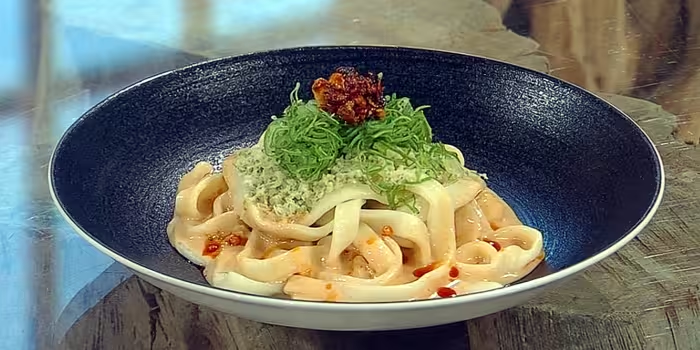
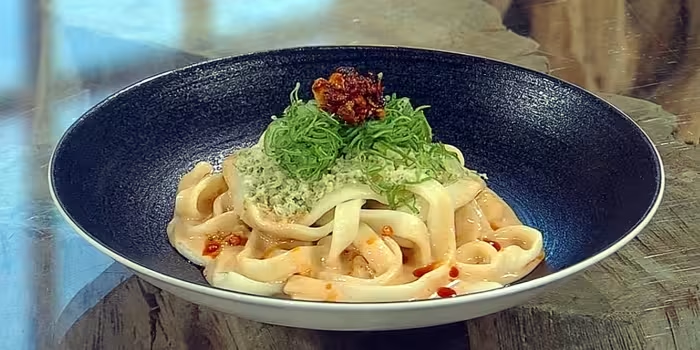
Learn how to make chilled udon noodles with sesame vinaigrette from chef Masaki Sugisaki. Handmade udon noodles, kneaded and rested the traditional way, are served cold with a creamy goma ponzu sesame and miso vinaigrette, then topped with shatteringly crisp aonori tempura flakes, fresh spring onions and optional chilli oil – a comforting Japanese classic and a brilliant vegetarian noodle recipe.
Jump To Recipe By Masaki Sugisaki
From Saturday Kitchen 10 Oct 2026
 This chilled udon noodle recipe earns a Nutri-Score of D. The sesame and miso vinaigrette brings beneficial fats and a little protein from tahini, but the refined white flour noodles, added sugar and relatively high salt across the brine, miso and soy sauce push the score down. Enjoy as an occasional treat and go easy on the extra chilli oil if you are watching salt.
Shop the Recipe
The kit that makes this recipe easy:
- Pasta machine – a must for rolling the dough evenly to 2-3mm and cutting neat tagliatelle-width udon noodles.
- Large mixing bowl – to mix and rest the dough comfortably.
- Blender – great for whizzing the sesame and miso vinaigrette silky smooth.
- Cooking thermometer – ideal for holding the frying oil at a steady 180C.
- Deep heavy-based pan – for safely deep-frying the tempura flakes.

Ingredients
For the udon noodles
- 20g sea salt, dissolved in 155ml/5fl oz water to make a brine
- 400g/14oz 00 flour
- tapioca starch, for dusting
- 1 tbsp cider vinegar, for the cooking water
For the goma ponzu vinaigrette
- 150ml/5fl oz mirin
- 100ml/3½fl oz rice vinegar
- 80g/3oz tahini
- 60g/2¼oz shiro miso (white miso)
- 40ml/1½fl oz sesame oil
- 20g/¾oz caster sugar
- 20ml/¾fl oz soy sauce
- pinch cayenne pepper
For the tempura flakes
- 180ml/6fl oz cold water
- 80g/3oz tempura flour
- pinch aonori seaweed
- vegetable oil, for deep-frying
To serve
- 4 spring onions, sliced, washed and drained
- chilli oil (optional)
Customise
- Swap the shiro miso for an equal amount of aka miso (red miso) for a deeper, saltier dressing – start with 50g and taste.
- No tapioca starch? Use cornflour for dusting – it prevents sticking just as well.
- Make it gluten-free by using a gluten-free soy sauce or tamari; everything else is naturally gluten-free.
- Cider vinegar in the boiling water can be replaced with rice vinegar.
How the timings work
- No oven here – the clock is the dough’s resting schedule: one 30-minute rest, then a 2-hour rest, then at least another 2-hour rest. The whole recipe spans roughly 5½ hours, of which only about an hour is hands-on.
- During the first 30-minute rest: make the goma ponzu vinaigrette in the blender and chill it, and slice, wash and drain the spring onions.
- During the second 2-hour rest: there is nothing to do – the fridge-cold vinaigrette and prepared spring onions simply wait.
- During the final 2-hour rest: set up the frying station later in this window, and just before rolling, prepare a large bowl of iced water for refreshing the cooked noodles.
- Finally, a 20-25 minute active stretch: roll and cut the noodles, boil for 4 minutes, chill in iced water, then fry the tempura flakes while the noodles drain. Everything lands on the table cold and crisp together.
Method
First, make and knead the udon dough (about 15 minutes)
- Dissolve the salt: stir the 20g sea salt into 155ml/5fl oz water until it has completely dissolved – this brine seasons the udon noodles from within.
- Make a well: tip the 400g of 00 flour into a large bowl and make a well in the centre. Pour the brine into the well and gently flick the surrounding flour over the liquid without pressing down.
- Mix like a rake: using your fingertips rather than your palms, quickly mix in a circular motion, fingers pointing down. Keep going until the flour is no longer powdery and you have small, even crumbs – pressing now makes tough noodles.
- Bring it together: once the moisture is evenly distributed, press the mixture firmly with both hands into a single solid piece of dough. It should feel stiff and shaggy, not smooth yet – that comes from the treading.
Stomp, fold and rest (30-minute rest)
- Bag it up: put the dough in a thick, food-safe plastic bag. Slowly step on the dough using your body weight to flatten it – this is the traditional Japanese way and develops the gluten’s satisfying chew.
- Fold and repeat: remove the dough from the bag, fold it back into a ball, then repeat the flattening and folding process once more. Return it to the bag and leave to rest at room temperature for 30 minutes.
- Meanwhile, make the vinaigrette: while the dough rests, put the mirin, rice vinegar, 100ml/3½fl oz water, tahini, shiro miso, sesame oil, caster sugar, soy sauce and cayenne pepper in a blender. Blend until completely smooth, then chill. (During this same window, slice the spring onions, wash them and drain well – wet onions dilute the dressing.)
Two long rests while everything else waits (about 4 hours, hands-off)
- Stomp once more, then rest: repeat the flattening and folding process, then leave the dough to rest in the bag for 2 hours. This long rest lets the gluten relax so the dough rolls without springing back.
- Flatten and rest again: step on the dough once more to flatten it – keep it flat this time rather than shaping it into a ball – then return it to the bag and leave to rest for at least another 2 hours. There is nothing to do in this window; just before the next stage, prepare a large bowl of iced water for refreshing the noodles.
Roll and cut the noodles (about 15 minutes)
- Roll it out: using a rolling pin or pasta machine, roll the dough into sheets 2-3mm/⅛in thick – thin enough that you can just see your hand through the sheet.
- Cut into strips: lightly dust the sheet with tapioca starch and fold it over so it is easier to cut. Using a sharp knife, cut into 5mm/¼in-wide strips – or use the tagliatelle cutter on a pasta machine for even noodles.
- Dust and shake: dust the cut noodles generously with tapioca starch, then shake off any excess so the boiling water does not turn gluey.
Boil and chill the noodles (about 10 minutes)
- Boil: bring a large saucepan of water to the boil and add the cider vinegar – it firms the noodles slightly. Add the noodles and boil for 4 minutes; they should be springy and just cooked through, with no chalky centre.
- Refresh immediately: drain, then plunge straight into the iced water to stop the cooking and wash off surface starch – this is what gives chilled udon its slippery, bouncy bite.
While the noodles chill, fry the aonori tempura flakes (about 10 minutes)
- Mix the batter: whisk the cold water, tempura flour and aonori in a bowl – roughly mixed rather than smooth. Lumps of flour are what create the crisp, feathery flakes.
- Heat the oil: heat vegetable oil in a deep, heavy-based pan to 180C, checked with a cooking thermometer. CAUTION: hot oil can be dangerous – do not leave it unattended.
- Fry the flakes: carefully drizzle the batter into the hot oil in small batches and fry until the bubbling stops and the flakes are pale gold and crisp.
- Drain: remove the tempura flakes with a slotted spoon and drain on kitchen paper so they stay crisp rather than greasy.
Assemble and serve (about 5 minutes)
- Dress the bowls: pour the chilled goma ponzu vinaigrette into serving bowls.
- Build the dish: add the chilled udon noodles, then top with the aonori tempura flakes and the drained spring onions.
- Finish: drizzle with chilli oil, if using, and serve straight away while the flakes are still crisp.
Tips and swaps
- Get ahead: the dough can rest in the fridge overnight after the second flattening – bring it back to room temperature for 30 minutes before rolling. The vinaigrette keeps for 3 days in the fridge.
- Swaps: no pasta machine? A rolling pin works – just roll patiently to 2-3mm. Store-bought udon (about 400g fresh) makes this a 30-minute recipe; skip straight to boiling.
- Failure point: if the noodles stick together after cutting, you have not dusted enough – toss them through more tapioca starch and shake off the excess before boiling.
- Leftovers: keep cooked noodles in the fridge for up to 2 days; the vinaigrette keeps for 3. Refresh noodles in boiling water for 30 seconds, chill again, then reheat any leftover flakes in a 180C oven for 5 minutes until crisp – check they are hot rather than trusting the clock.
- Vegans: this recipe is already free of animal products, so it suits a vegan diet as written.
- Safety: never move the pan of hot oil until it has cooled completely.
Wine Pairing
Recommended by Helen McGinn:
Finest Grüner Veltliner, Austria, 2025 — Tesco, From £9
A Grüner Veltliner is a natural partner for cold noodle dishes dressed in sesame. Its fresh acidity cuts through the rich, nutty tahini and miso dressing, while its signature peppery character echoes the gentle heat of the cayenne and optional chilli oil. Served well chilled, it is refreshing against the cool, slippery noodles.
Here are equally good alternatives that pair beautifully with this dish:
Albert Heinz Grüner Veltliner — Aldi, around £7
A budget-friendly Austrian white with the same fresh, peppery character – bright enough to lift the sesame dressing without overwhelming it.
Marseille rosé — Sainsbury’s, around £9
A dry Provençal-style rosé works nicely here; its crisp acidity and subtle red-berry fruit suit both the miso richness and the fresh spring onions.
Willi Bründlmayer Grüner Veltliner Kamptal — Waitrose, around £17
A premium Austrian example with more depth and texture, standing up confidently to the creamy tahini and umami-rich miso.
Prices checked October 2026 and may vary. The alternatives are our suggestions, not necessarily wines recommended by Helen McGinn.
Recipes from this episode
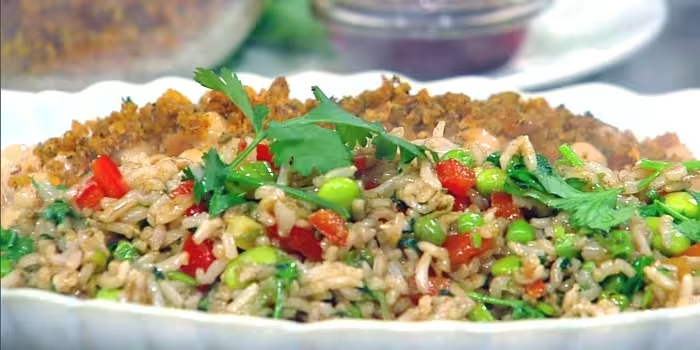
Gold satay-style chickpeas with spiced fried rice and a chickpea crumb
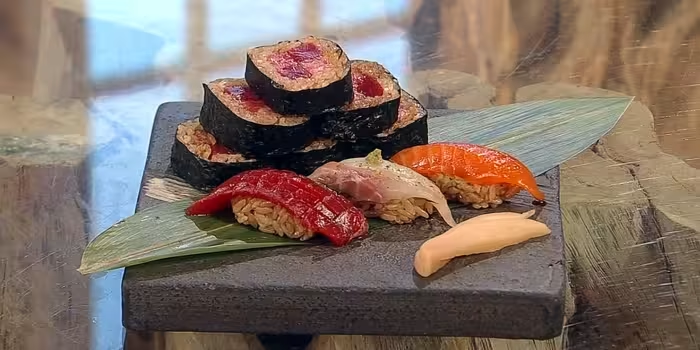
Tuna, sea bass and trout nigiri and British tuna rolls
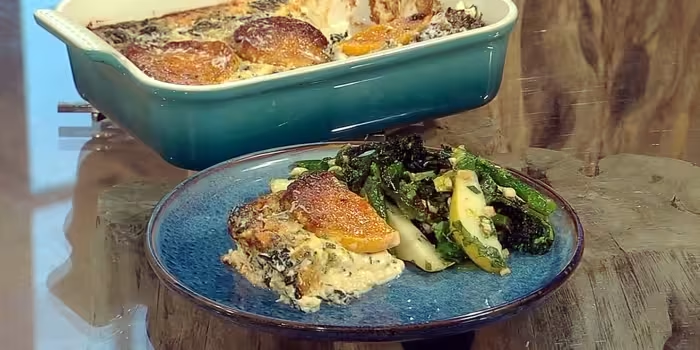
Butternut squash and cavolo nero gratin
Hake with fennel and sun-dried tomatoes

Gilda butter lamb chops with smashed cucumber salad
Chilled udon noodles with sesame vinaigrette
Notes:
- Timing discrepancy reported: the original states “Prepare: over 2 hours”, but the method requires a 30-minute rest plus two 2-hour rests (4½ hours total resting). I adjusted Prep to “30 mins hands-on, plus 4½ hrs resting” to match the Method step for step.
- Dietary information: the original BBC recipe said “HealthyVegetarian”. Every ingredient is plant-based, so the recipe is accurately vegan (assuming a vegan-friendly sugar) – I used “Vegetarian, vegan-friendly” and suitableForDiet “VeganDiet” in the schema. “Healthy” was removed as it is subjective.
- Precise cooking check: for the fried tempura flakes, doneness is confirmed by the bubbling stopping and pale-gold colour; oil temperature must be 180C for safety and texture.
- Ingredient correction: the original BBC recipe listed “40ml/1fl½ oz sesame oil” – standardised this to 40ml/1½fl oz (consistent unit formatting).
- Nutri-Score: calculated as D, based on high sodium (brine, miso, soy sauce), refined flour and added sugar, offset only slightly by sesame protein.
- Equipment: the pasta machine was deemed an essential item and genuinely central to the recipe’s success.
